

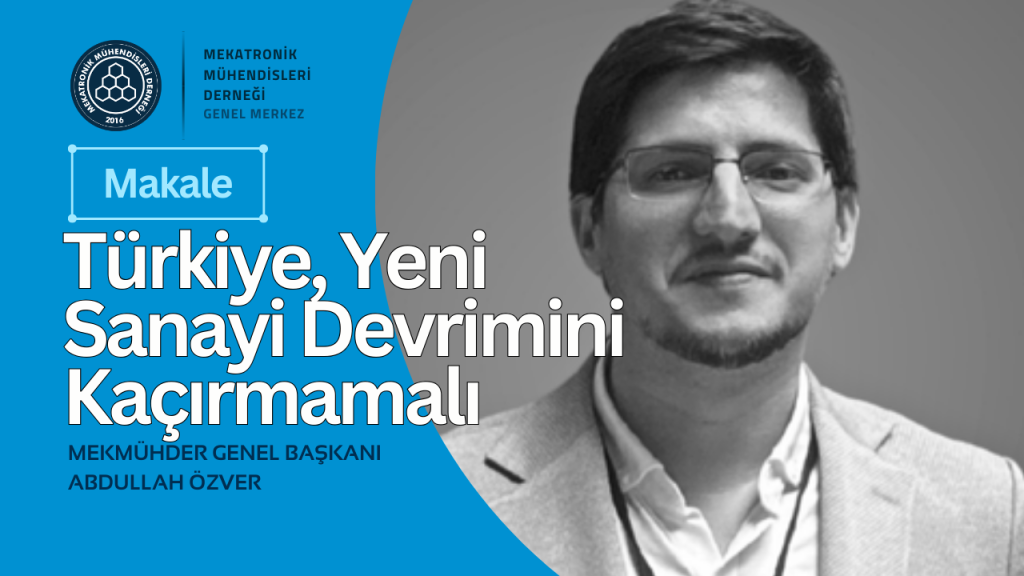
Genel Başkanımız M. Abdullah Özver tarafından kaleme alınan yazı; yapay zekâ, robotik ve mekatronik alanlarında dünyadaki hızlı dönüşüme vurgu yapmakta, Türkiye’nin teknoloji odaklı üretim vizyonuna ilişkin önemli değerlendirmeler içermektedir.
Mekatronik Çağı Başladı: Türkiye, Yeni Sanayi Devrimini Kaçırmamalı
Dünya, insanlık tarihinin en hızlı teknolojik dönüşümünün içinden geçiyor. Yapay zekâ destekli otomasyon yapıları, çevrimdışı karar verebilen robotlar, yüksek hassasiyetli elektronik–mekanik sistemler ve karmaşık kontrol algoritmaları artık her sektörün temel unsuru hâline geldi.
Robotik sistemler yalnızca fabrikalarda değil; evlerde, hastanelerde, sokakta ve gündelik hayatın içinde karşımıza çıkıyor. Bugün ev robotları, insansı robotlar, yapay zekâ ile kontrol edilen otomasyon yapıları, sürü robot teknolojileri, drone tabanlı uygulamalar ve bazı ülkelerin geliştirdiği robot asker–robot polis prototipleri hayatın gerçeği. Bir zamanlar hayal gibi görünen bu sistemler artık günlük yaşamın doğal bir parçası.
Geleceğe yön vermek isteyen gelişmiş ülkelerin tamamı mekatronik sistemleri kendi altyapılarına çoktan entegre etti ve bu alanda birbirleriyle yarışıyor. Mekatronik mühendisliği artık geleceğin değil; doğrudan bugünün gerçeği. Sanayi devrimi geride kaldı; artık kesintisiz bir mekatronik devinimi başladı.
Yeni çağ, mekatronik çağıdır.
Bu çağın gereğini yerine getiren ülkeler geleceği belirleyecek; gereğini yapmayanlar ise başkalarının ürettiği teknolojilere mahkûm olacak.
Yeni Nesil Mühendislik Anlayışı
Bir zamanlar bilim kurgu filmlerinde gördüğümüz teknolojiler, bugün genç mühendislerin ellerinde gerçeğe dönüşüyor.
Artık lise ve üniversite çağındaki gençler bile:
- kendi roketlerini tasarlıyor,
- insansız hava araçları geliştiriyor,
- uçan arabalar üzerinde çalışıyor,
- otonom kara araçları üretiyor,
- yüksek hızlı ulaşım sistemlerine çözümler geliştiriyor,
- karmaşık elektronik ve kontrol sistemleri kuruyor,
- yapay zekâ tabanlı karar mekanizmaları geliştiriyor.
Yeni nesil mühendislik artık makine, elektronik veya yazılımı ayrı başlıklar olarak görmüyor. Bu alanların hepsini tek bir bütünün parçaları olarak kullanıyor. Bu tablo, mekatronik mühendisliğinin Türkiye’nin geleceğinde neden kritik bir rol üstlendiğini açıkça gösteriyor. Gençlerin baktığı yön, çalıştığı konular ve geliştirdiği projeler, ülkemizin stratejik ekseninin mekatronik olduğunu net biçimde ortaya koyuyor.
Türkiye kritik bir eşikte: Yine yeni sanayi devrimini kaçıracak mıyız?
Tarih bize şunu gösteriyor:
- Birinci sanayi devrimini kaçıran ülkeler onlarca yıl geriden geldi.
- İkinci ve üçüncü sanayi devriminde geri kalanlar kendi endüstrilerini kurmakta zorlandı.
- Bugün yaşadığımız dördüncü sanayi devrimi ise robotik, yapay zekâ ve mekatronik odaklı bir dönüşüm.
Bu nedenle artık sorulması gereken soru çok net:
Türkiye, robotik ve yapay zekâ çağını kaçıracak mı, yoksa bu çağın öncülerinden biri mi olacak?
Türkiye’deki mühendislik kültürü güçlü; fakat teknoloji 10 yıl boyunca kimseyi beklemedi.
Türkiye’de köklü bir mühendislik kültürü var. Bu kültürü yıllardır ayakta tutan, disipline eden ve geliştiren güçlü yapılar mevcut. Makine Mühendisleri Odası (MMO, 1954), Elektrik Mühendisleri Odası (EMO, 1954) ve diğer tüm odalar kendi alanlarında ülkemize değerli katkılar sağlamayı sürdürüyor. Bu birikimi görmezden gelmek mümkün değil.
Ancak bir gerçeğin altını çizmek gerekiyor:
Son kurulan mühendislik odası 2012 yılında kurulan Bilgisayar Mühendisleri Odası (BMO) oldu.Aradan geçen 13 yılda dünya, insanlık tarihinin en hızlı teknolojik sıçramalarından birini yaşadı.
Teknoloji 10 yıl boyunca kimseyi beklemedi.
- Yapay zekâ kendi kendine öğrenebilen bir yapıya dönüştü.
- Robotik sistemler olağanüstü bir hızla gelişti.
- Sensör, kontrol ve yazılım teknolojileri bambaşka bir seviyeye ulaştı.
- Otonom sistemler pek çok sektörde standart hâline geldi.
Dünya robotik ve yapay zekâ merkezli bambaşka bir yöne ilerlerken, mühendislik temsil yapılarının da bu hıza uyum sağlaması artık kaçınılmaz.
Burada kimseyi eleştirmek niyetinde değiliz.
Sadece şu gerçeği ifade ediyoruz:Bugünün mühendislik sorunları, 70 yıl önce kurulmuş kurumsal yapılara göre şekillenmek zorunda değil.
Mekatronik mühendisliği artık klasik mühendislik anlayışının ötesinde
Mekatronik; mekanik, elektronik, yazılım, kontrol ve yapay zekâ gibi alanların aynı anda ve bütünleşik şekilde yürütüldüğü yeni bir mühendislik paradigmasıdır.
Ne bir alt dal, ne de geçici bir birleşimdir. Klasik oda tanımlarına sığması mümkün olmayan, kendi doğası olan bağımsız bir mühendislik alanıdır.
Bu disiplin artık:
- kendi uzmanlık alanına,
- kendi yetkinliklerine,
- kendi sorumluluklarına,
- kendi teknik sınırlarına
sahip özgün bir mühendislik bakış açısını temsil ediyor.
Bu nedenle yeni bir mühendislik odası artık ertelenemeyecek bir ihtiyaçtır.
Mekatronik Mühendisleri Odası, yalnızca meslek mensupları için değil; Türkiye’nin teknoloji politikası için de gereklidir.
Bu bir talep değildir — bir zorunluluktur.
Bu adım:
- bir rekabet değil,
- bir çatışma değil,
- yerine geçme iddiası da değildir.
Yeni bir oda:
- Mesleğin standartlarını belirleyecek,
- Yetkinlik alanlarını netleştirecek,
- Genç mühendislerin geleceğini güvence altına alacak,
- Teknolojide nitelikli insan kaynağını güçlendirecek,
- Türkiye’nin üretim ve rekabet kapasitesine doğrudan katkı sağlayacaktır.
Bu herhangi bir yapıya karşı bir hamle değil; Türkiye’nin teknoloji çağındaki yerini sağlamlaştırmaya yönelik tamamlayıcı bir vizyondur. Mevcut yapılar kendi alanlarında değer üretmeye devam ederken, Mekatronik Mühendisleri Odası ise yeni teknolojik dönemin lokomotifi olacaktır.
M. Abdullah Özver
Genel Başkan
Mekatronik Mühendisleri Derneği
The article authored by our President M. Abdullah Özver emphasizes the rapid global transformation in the fields of artificial intelligence, robotics, and mechatronics, and presents important assessments regarding Türkiye’s vision for technology-oriented production.
The Mechatronics Era Has Begun: Türkiye Must Not Miss the New Industrial Revolution
The world is undergoing the fastest technological transformation in human history. AI-driven automation structures, robots capable of making offline decisions, high-precision electro-mechanical systems, and complex control algorithms have now become fundamental elements of every sector.
Robotic systems are no longer confined to factories; they are present in homes, hospitals, streets, and daily life. Today, domestic robots, humanoid robots, AI-controlled automation systems, swarm robotics technologies, drone-based applications, and even robot soldier–robot police prototypes developed by some countries are a reality of life. Systems that once seemed like science fiction are now a natural part of everyday living.
All developed countries seeking to shape the future have already integrated mechatronic systems into their infrastructures and are competing with one another in this field. Mechatronics engineering is no longer the reality of the future—it is the reality of today. The industrial revolution is behind us; an uninterrupted mechatronic momentum has begun.
The new era is the mechatronics era.
Countries that fulfill the requirements of this era will shape the future; those that fail to do so will be condemned to depend on technologies produced by others.
A New-Generation Engineering Approach
Technologies once seen only in science fiction films are now being brought to life by the hands of young engineers.
Today, even high school and university students are:
- designing their own rockets,
- developing unmanned aerial vehicles,
- working on flying cars,
- producing autonomous ground vehicles,
- developing solutions for high-speed transportation systems,
- building complex electronic and control systems,
- creating AI-based decision-making mechanisms.
New-generation engineering no longer treats mechanical, electronic, or software engineering as separate domains. Instead, it uses all of these fields as components of a single integrated whole. This picture clearly demonstrates why mechatronics engineering plays a critical role in Türkiye’s future. The direction young people are looking toward, the topics they are working on, and the projects they are developing clearly reveal that Türkiye’s strategic axis is mechatronics.
Türkiye at a Critical Threshold: Will We Miss the New Industrial Revolution Again?
History shows us that:
- Countries that missed the first industrial revolution fell decades behind.
- Those that lagged during the second and third industrial revolutions struggled to establish their own industries.
- The fourth industrial revolution we are experiencing today is centered on robotics, artificial intelligence, and mechatronics.
Therefore, the question that must now be asked is clear:
Will Türkiye miss the era of robotics and artificial intelligence, or will it become one of its pioneers?
Türkiye’s Engineering Culture Is Strong—But Technology Does Not Wait
Türkiye has a deeply rooted engineering culture. Strong institutions that have sustained, disciplined, and developed this culture for decades continue to make valuable contributions to our country. The Chamber of Mechanical Engineers (MMO, 1954), the Chamber of Electrical Engineers (EMO, 1954), and all other chambers persist in adding value within their respective fields. This accumulated experience cannot be ignored.
However, one fact must be underlined:
The most recently established engineering chamber was the Chamber of Computer Engineers (BMO) in 2012. In the 13 years since then, the world has undergone one of the fastest technological leaps in human history.
Technology did not wait for anyone for ten years.
- Artificial intelligence evolved into self-learning systems.
- Robotic systems advanced at an extraordinary pace.
- Sensor, control, and software technologies reached entirely new levels.
- Autonomous systems became standard across many sectors.
As the world moves rapidly toward a robotics- and AI-centered direction, it has become inevitable for engineering representation structures to adapt to this pace.
There is no intention here to criticize anyone.
We are simply stating the following reality:
Today’s engineering challenges do not have to be shaped according to institutional structures established 70 years ago.
Mechatronics Engineering Goes Beyond the Classical Engineering Paradigm
Mechatronics is a new engineering paradigm in which mechanical, electronic, software, control, and artificial intelligence fields are conducted simultaneously and in an integrated manner.
It is neither a sub-branch nor a temporary combination. It is an independent engineering discipline with its own nature—one that cannot be confined within classical chamber definitions.
This discipline now represents a unique engineering perspective with:
- its own areas of expertise,
- its own competencies,
- its own responsibilities,
- its own technical boundaries.
For this reason, the establishment of a new engineering chamber is no longer a postponable need.
The Chamber of Mechatronics Engineers is necessary not only for professionals, but also for Türkiye’s technology policy.
This is not a demand—it is a necessity.
This step is:
- not a competition,
- not a conflict,
- nor a claim to replace any existing structure.
A new chamber will:
- define professional standards,
- clarify competency domains,
- secure the future of young engineers,
- strengthen the qualified technological workforce,
- directly contribute to Türkiye’s production and competitiveness capacity.
This is not a move against any existing institution; it is a complementary vision aimed at solidifying Türkiye’s position in the technological era. While existing structures continue to create value within their own fields, the Chamber of Mechatronics Engineers will serve as the locomotive of the new technological age.
M. Abdullah Özver
President
Mechatronics Engineers Association